Barnett’s Grove: The Rise and Fall of an Evansville Pleasure Park
Imagine a place where thousands of Evansville residents gathered every weekend. Families spread picnic lunches beneath enormous trees. Music drifted across open lawns. Sweethearts wandered through shaded woods in a setting locals remembered as something out of a poem.
Now imagine that place disappearing so completely that you could drive through the area without realizing it had ever existed.
That is the story of Barnett’s Grove, once a beloved destination for outdoor recreation and social life. Originally known as Olympic Park, it flourished during the late 19th and early 20th centuries, when a railroad trip could turn an ordinary weekend into a countryside escape.
Its rise and disappearance reveal something fascinating about how cities change: the transportation that makes a destination successful can also help make it obsolete.
Before a Weekend Escape Was Easy
To understand why Barnett’s Grove mattered, picture Evansville in the late 1800s. It was a much smaller city, without the cars and highway networks that now make a trip across town feel routine.
For many residents, getting beyond the city was difficult, tiring, and expensive. Recreation and community life largely stayed close to home, not necessarily because people lacked curiosity, but because they lacked convenient transportation.
A shady park several miles away might sound like a modest outing today. Back then, simply reaching it could be the obstacle that kept a family from going at all.
Then the railroad changed the possibilities.
The ES&N Railroad Opens Up a New World
Formed in 1889, the ES&N railroad served the growing movement of people, goods, and trade between Evansville and Newburgh. Its route began at Fifth Street, followed the old Wabash and Erie Canal, and swung southeast through the areas of Wesselman Park and the state hospital grounds before reaching Water Street in Newburgh.
For its first 16 years, the line used small steam engines known as dummy locomotives. In 1905, it was electrified for interurban cars.
The importance of the line went well beyond commerce. Affordable, quick rail travel brought destinations outside the immediate city within reach of ordinary residents. A trip into the countryside no longer had to be an exhausting undertaking.
F. W. Cook’s clever reason to build a park
The railroad’s owner, F. W. Cook, also had a brewery, and he recognized a particularly useful connection between transportation and recreation.
Cook had leased property on Evansville’s east side as pasture for his brewery’s horses. The railroad passed right by it. That turned an otherwise practical piece of land into a business opportunity.
Build an appealing pleasure park beside the route, and people would have a reason to buy train tickets on Saturdays and Sundays. The railroad would not merely serve an existing destination. It could help create demand for one.
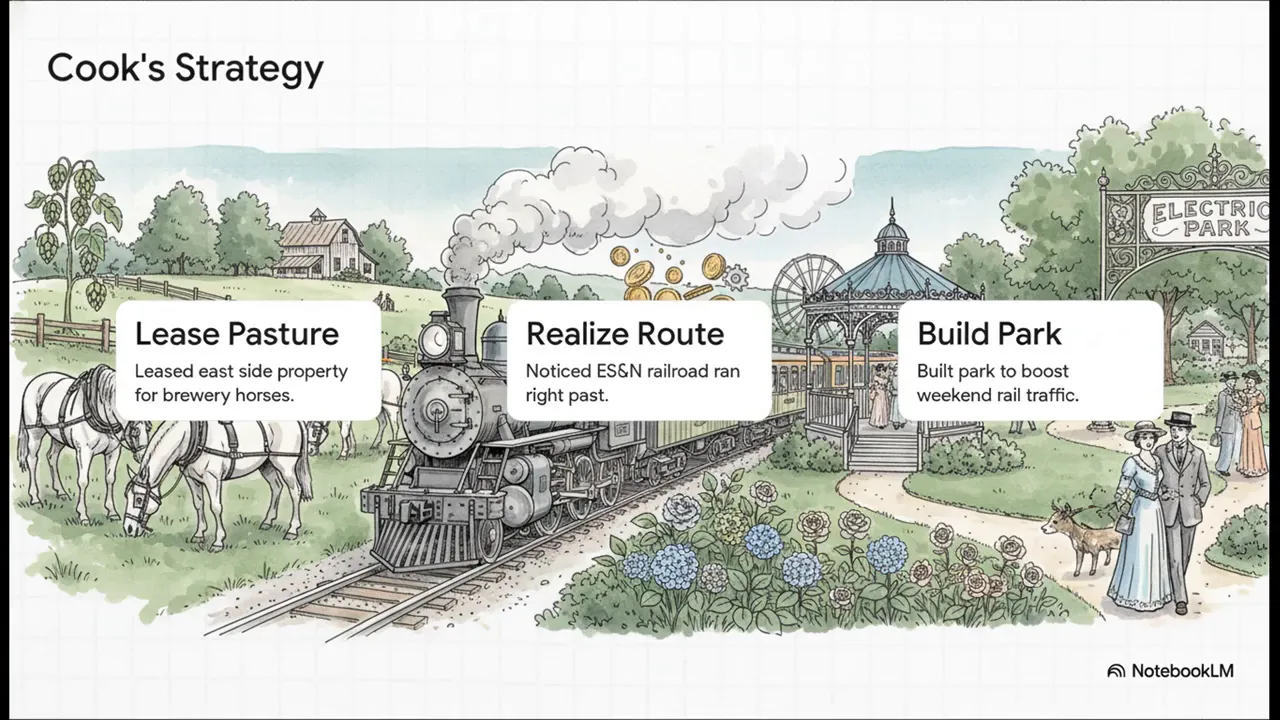
It was a smart arrangement: the park supplied the attraction, the train supplied the access, and weekend passenger traffic supported the business.
The Golden Age of Private Groves
Cook’s idea fit neatly into a broader enthusiasm for outdoor recreation. Across the region, privately operated groves became places where people could gather, relax, and enjoy a change of scenery.
But what exactly was a grove?
In this setting, it was not a tangled patch of wilderness. A recreational grove was a carefully maintained landscape, with groups of similar trees, generous spacing, and underbrush cleared away. The appeal was nature made comfortable and accessible: shade overhead, open ground below, and room to stroll or spread out a picnic.
Cheap rail travel helped destinations such as Gilbert’s Grove, Kubler’s Garden in Newburgh, and Barnett’s Grove become regional gathering places.
Church groups organized outings. Companies held large picnics. Families could spend a day outdoors together without arranging a difficult journey of their own.
These pleasure grounds helped lay the groundwork for the modern American amusement park. Their central attraction was organized leisure: a place worth traveling to, shared entertainment, and a practical way to get there. For Evansville residents, they helped establish a new rhythm of weekend recreation.
Inside Barnett’s Grove
Barnett’s Grove stood about five miles from the city in Knight Township, between Newburgh Road and Washington Avenue. Earlier known as Olympic Park, it became one of the most popular destinations of the grove era.
Its reputation was not simply that of a convenient picnic ground. Historical descriptions emphasized its romantic beauty, portraying it as a refuge for sweethearts whose scenery belonged in poetry.
That gives us a sense of what people valued there. This was somewhere to escape the ordinary, meet friends, enjoy music, and spend an afternoon in surroundings that felt special.
A weekend beneath the poplars
On Saturdays and Sundays, thousands of people traveled out by rail to enjoy the grounds. A day at Barnett’s Grove could include:
- Long walks through the cleared woods.
- Organized games on the broad lawns.
- Live musical entertainment.
- Picnic lunches beneath a canopy of mature trees.
The trees were the park’s crowning feature. Great poplars spread their shade over the picnic grounds, offering relief from the summer heat. Historical accounts praised them as exceptionally beautiful, unlike anything else near Evansville.
It is easy to focus on the crowds or the entertainment, but that canopy was fundamental to the experience. The grove offered both a social destination and a comfortable outdoor retreat. Its beauty was not incidental to its popularity. It was the reason people wanted to linger.
When Cars Changed the Weekend
The great irony of Barnett’s Grove is that transportation helped create its success, then helped undo it.
Interurban trains made a nearby pleasure park an easy choice. But automobiles offered a different kind of freedom. Instead of choosing among destinations along a fixed rail route, people could select their own roads, travel farther, and shape an outing around their individual interests.
The train made the grove accessible. The car made countless other destinations accessible, too.
As automobile travel and highways expanded, local interurban service lost its importance. That weakened the dependable connection between the park and the crowds that had sustained it.
Without trains delivering large numbers of visitors to its doorstep each weekend, Barnett’s Grove faced a very different future.
From Pleasure Park to Roadhouse to Residential Lots
The property did not immediately disappear into development. It went through several attempts at finding a new purpose.
- A roadhouse: The site became Club Deville, promoting live music and late-night dancing.
- A religious camp: In the mid-1930s, it briefly operated as a Bible Institute camp.
- Residential development: As those uses faded, the land was ultimately sold and subdivided into smaller residential lots.
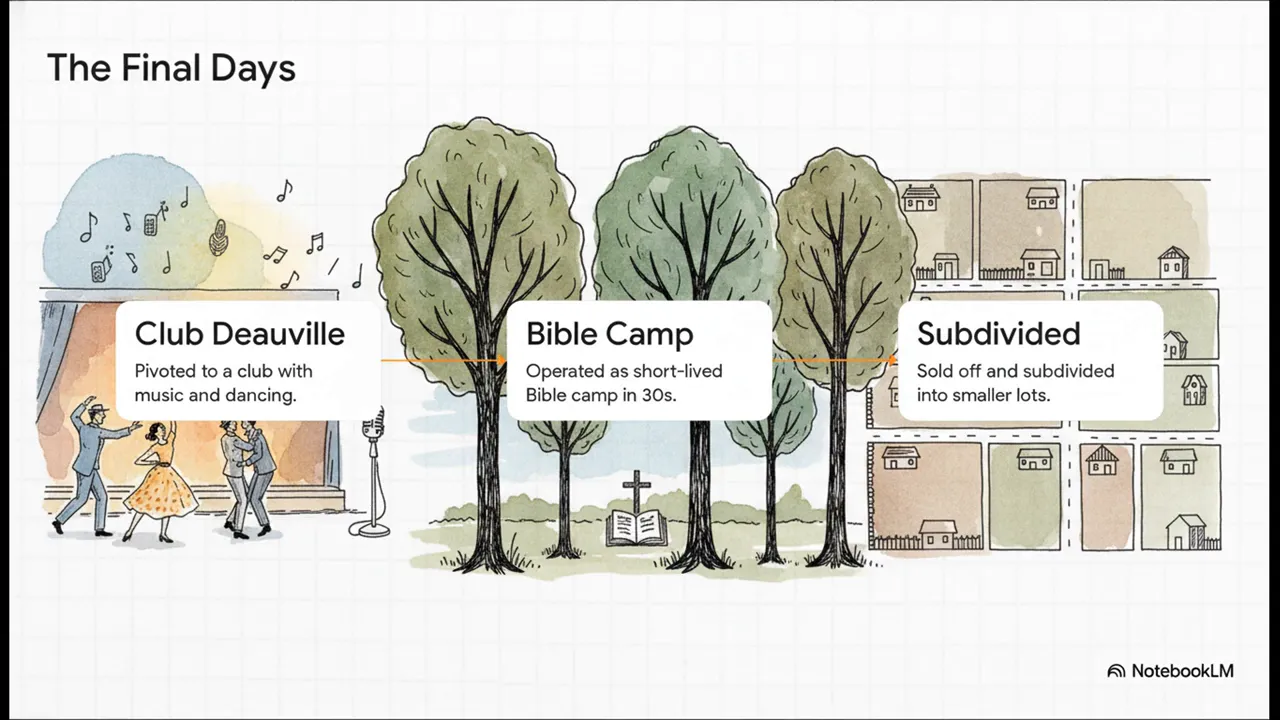
Each change moved the property farther from its original role as a shared weekend retreat. Music and dancing offered one way to keep it active. The camp offered another. Neither preserved the grove as the gathering place it had once been.
Eventually, even the magnificent poplars could not sustain the property’s old purpose. The broad grounds gave way to individual lots, and the landscape became part of an expanding city.
The History Beneath an Ordinary Commute
Today, the area between Newburgh Road and Washington Avenue offers little visible indication of the pleasure park that once drew such crowds. The great trees and picnic lawns are gone. Former railroad rights-of-way remain among the few traces of the transportation landscape that made the grove possible, largely obscured by development.
For anyone curious about how an urban landscape has changed, historical maps offer a useful starting point. The Library of Congress’s Sanborn Maps collection is one resource for exploring older street patterns and built environments, alongside local historical records.
Barnett’s Grove is more than a vanished Evansville landmark. Its story captures a larger shift in American life: from shared rail excursions to personal automobile trips, and from spacious pleasure grounds to residential neighborhoods.
What once felt permanent could disappear within a changing city. A place remembered for romance, music, and extraordinary trees could become an unremarkable stretch of someone’s daily route.
That is what makes this history worth remembering. The next time an ordinary road seems to have nothing to tell you, consider what might have stood beside it before the houses, before the traffic, and before the asphalt. Sometimes a city’s most surprising stories are hidden in the places we pass every day.
Made with VideoToBlog using Barnett’s Grove: The Rise and Fall of a Pleasure Park
Comments