Monday, November 2, 2026

Celebrate National Take a Hike Day on November 17


There's still time to get outside and enjoy the beauty of fall in Kentucky. Cooler temperatures, colorful leaves underfoot and sweeping views make November a wonderful time to explore a new trail or revisit a favorite. 
 
Celebrate National Take a Hike Day on November 17 with a walk through the woods, a family outing or a little time on the trail to clear your head. Looking for inspiration? The Kentucky Geological Survey’s Kentucky Arch Trail connects some of the state's most striking natural landscapes, including Carter Caves State Resort Park, Natural Bridge State Resort Park, Kingdom Come State Park and Pine Mountain State Resort Park. 
 
Whether you're checking another arch off your list or simply enjoying the crisp fall air, your next outdoor adventure may be closer than you think. 
 
Find a trail, choose your park and make a day of it!


Explore Kentucky State Park Trails

Sunday, November 1, 2026

Discover Your Next Adventure Close to Home


Explore scenic trails, peaceful parks, and the stories behind the places you love with Southern Indiana Trails.

Find inspiration for your next outdoor outing, discover regional destinations, and explore local history—from Evansville’s Roberts Stadium legacy to the evolving green space of Roberts Park.

Whether you’re planning a weekend walk or looking for somewhere new to explore, start your journey here.

Visit Southern Indiana Trails

Explore the Outdoors. 

Discover the History.

From Stadium to Park


Today 7:22 PM


From Stadium to Park: The Rebirth of Evansville’s Historic Grounds

For more than half a century, the corner of Division Street and Boeke Road was synonymous with cheering crowds, roaring rock concerts, and basketball history. Today, the pavement and grandstands are gone, replaced by open grassy fields and the quiet rustle of nearby trees .

The transformation of Roberts Municipal Stadium into Roberts Park is one of Evansville’s most significant urban renewal stories—a journey from a bustling mid-century arena to a revitalized community green space.


1956: A Mid-Century Landmark Arrives

In the early 1950s, Evansville Mayor Hendrik O. Roberts championed the construction of a modern indoor arena capable of hosting major athletic tournaments, conventions, and expositions. When it opened in 1956, Roberts Municipal Stadium seated roughly 12,500 fans beneath an iconic arched roofline.

Almost immediately, the arena became the cultural and athletic epicenter of southwestern Indiana:

  • National Champions: Under legendary coach Arad McCutchan, the University of Evansville Purple Aces captured five NCAA College Division national championship titles on the Roberts Stadium hardwood.

  • Touring Legends: From rock icons like KISS, AC/DC, Rush, and Van Halen to country headliners, the arena was the Tri-State’s premier concert stop.

  • Community Traditions: For 56 straight years, families gathered every Thanksgiving weekend for the annual Hadi Shrine Circus, alongside decades of high school graduations and civic gatherings.


The End of an Era (2011–2013)

By the early 2000s, the aging arena faced rising maintenance demands and lacked modern amenities. In late 2011, the city opened the downtown Ford Center as its new multi-purpose entertainment venue, bringing active operations at Roberts Stadium to a close.

Despite civic proposals to repurpose the structure, the building was demolished in 2013 . Rather than selling the valuable land to commercial developers, the city dedicated the site as permanent public parkland: Roberts Park .


Transition to Open Green Space

In the years following demolition, Roberts Park evolved into an open-air commons . The spacious lawn quickly became a neighborhood favorite for informal recreation:

  • Casual walking and jogging

  • Dog walking and open field exercise

  • Frisbee, kite flying, and community gatherings

Its proximity to Wesselman Park and the ancient forest of Wesselman Woods Nature Preserve positioned the site as a natural gateway connecting urban Evansville with regional nature trails .


The Master Plan Vision

Rather than leaving the grounds as simple turf, the Evansville Department of Parks and Recreation created an expansive long-term vision integrating Roberts Park with Wesselman Park .

The comprehensive master plan outlines major proposed additions across the corridor:

  • Expanded Sports Facilities: Dedicated pickleball courts, multi-use basketball and sand volleyball courts, and refurbished shelters .

  • Reforestation & Meadow Restoration: Returning portions of the former par-3 golf course to native wet woods and successional meadows .

  • Multi-Use Trail Network: Adding 2.5 miles of dedicated pedestrian and bike trails that link neighborhood sidewalks, park paths, and the regional Greenway Passage .

  • New Nature Center & Playgrounds: An all-abilities destination playground and a new gateway facility for Wesselman Woods .


A Living Legacy

Where thousands once gathered under arena floodlights, future generations will walk shaded woodland paths, play on community courts, and enjoy expansive urban green space.

The transition from Roberts Stadium to Roberts Park honors Evansville’s past while investing in a healthier, more connected outdoor future .


Saturday, October 31, 2026

A Changing Climate on Our Local Trails


A Changing Climate on Our Local Trails

What warmer temperatures and heavier rain mean for southern Indiana and the surrounding region

Climate change can sound like a problem measured in distant places and future decades. But for people who enjoy local trails, its effects connect with familiar concerns: muddy paths, summer heat, washed-out crossings, and the health of the woods around us.

For trails across southern Indiana, western Kentucky, and southern Illinois, the central issue is resilience—how well paths, forests, and park facilities can handle changing conditions while remaining places people can enjoy.

Indiana research provides a clear regional warning. Purdue Extension reports that the state’s annual precipitation increased by approximately 6.5 inches between 1895 and 2019, based on the long-term trend. Heavy downpours are expected to increase, and wetter winters and springs are projected to raise flood risks. Those statewide findings do not describe every local trail, but they help explain the pressures trail managers must prepare for.

Heavier Rain Means More Than Muddy Shoes

Rain is essential to the forests and wetlands that make our trails appealing. The problem is how much falls at once, where it flows, and how long the ground stays saturated. Purdue Extension identifies increased flooding and soil erosion among the consequences of heavy rainfall.

Applied to trails, that creates several potential problems. Water running down a hillside path can carry away soil, deepen channels, and expose roots. Low areas may remain muddy, while stream crossings and drainage structures must handle larger flows. These are risks associated with heavier rainfall—not evidence that every damaged trail was harmed by climate change.

The distinction matters. A blocked drain, poorly routed trail, or unusually intense storm can cause trouble on its own. Climate change alters the broader conditions in which those problems occur; it does not provide a complete explanation for each washout.

For local hikers and mountain bikers, the practical result may be fewer usable days on a natural-surface trail, even during otherwise pleasant weather.

A Wetter Climate Can Still Bring Dry Periods

More annual rainfall does not mean consistently moist conditions throughout the year. Rain may arrive in concentrated downpours, separated by dry stretches. Higher temperatures and a longer growing season can also increase moisture demands on forests.

That combination helps explain why flooding and drought concerns can coexist. A trail system may experience saturated ground during one part of the year and dry, stressed vegetation later in the season. Purdue’s assessment projects wetter Indiana winters and springs, while changes in summer and fall precipitation carry more uncertainty.

For trail planning, annual rainfall totals are only part of the story. The timing and intensity of rainfall matter just as much.

Hotter Weather Changes the Outdoor Experience

Purdue’s Indiana Climate Change Impacts Assessment projects substantial warming and more very hot days as the century progresses. Its 2018 summary projected roughly 5–6°F of warming by mid-century, with outcomes depending on future emissions and the period being compared. These are projections, not a measurement of warming already completed.

For trail users, hotter conditions make the character of a route increasingly important. An open paved path and a shaded woodland trail can offer very different experiences on the same afternoon. Distance alone becomes a less useful measure of how demanding an outing will feel.

Trail systems may therefore need to serve visitors differently: retaining shade, maintaining reliable visitor information, and helping people identify shorter route options become increasingly relevant as temperatures rise. These are adaptation priorities suggested by the warming outlook, rather than claims that a particular local park has already adopted them.

The Woods Around the Trail Face Pressure Too

A trail is more than its walking surface. The surrounding trees and plants provide the setting that draws people outdoors.

Regional climate research describes how warmer temperatures, longer growing seasons, and more episodic rainfall can increase late-season moisture stress in Midwestern forests—even where annual precipitation rises. That means a wetter long-term climate does not automatically protect woodland ecosystems from dry-season stress.

Changes to the forest may unfold gradually rather than through a single dramatic event. For people who return to the same trail year after year, climate-related pressures become part of a larger stewardship challenge alongside invasive plants, development, pests, and everyday recreation impacts. Climate is one influence among several, not the sole explanation for changes in a particular woodland.

Tick Awareness May Extend Beyond Summer

Warmer conditions can also change when trail users encounter ticks. The Environmental Protection Agency reports that climate change has extended tick activity seasons and expanded suitable habitat for some tick species, creating more opportunities for human exposure.

That does not mean all tick species respond identically or that every local increase in tick encounters is caused by climate change. Habitat, wildlife hosts, land use, and other factors also influence tick populations and disease risk.

The practical message is that tick awareness should not be limited to the hottest months. EPA recommends staying near the center of marked trails and avoiding contact with brush, tall grass, and leaf litter where possible.

What This Means for Local Trail Care

A changing climate strengthens the case for maintaining trails before small problems become major repairs. The rainfall and erosion risks identified by Purdue point toward several useful priorities:

  • Keeping drainage features functioning so water does not remain on, or flow along, the trail.

  • Reviewing repeatedly damaged sections rather than rebuilding the same vulnerable alignment indefinitely.

  • Providing clear closure notices and reopening information.

  • Planning for hotter conditions as well as wetter ones.

  • Treating woodland health as part of trail management, not a separate concern.

These are planning implications of the regional research. The appropriate solution at any individual park still depends on its soils, slopes, waterways, habitat, and visitor use.

Avoid Blaming Every Bad Trail Day on Climate Change

A rainy weekend is weather. Climate describes patterns over longer periods.

Indiana’s documented rainfall trends and projected warming establish a meaningful background for local planning. They do not, by themselves, prove that climate change caused a particular fallen tree, muddy loop, or flooded parking area. Identifying the contribution to a specific event requires additional analysis.

That distinction makes the discussion more useful—not less urgent. We can recognize a changing risk without making unsupported claims about individual parks.

Keeping Our Trails Worth Returning To

Local trails connect people with places they care about: a neighborhood walking path, a wooded hillside, a lakeside route, or a familiar stretch of forest.

Protecting those experiences requires attention to both long-term climate trends and immediate trail conditions. Warmer temperatures, heavier downpours, and shifting seasonal patterns make thoughtful maintenance and flexible planning more important. The challenge is not simply keeping trails open; it is keeping them usable while protecting the landscapes that make them worth visiting.

How ticks ambush hikers


Friday, October 30, 2026

Respect the Edge: Staying Safe Around Cliffs and Rock Formations


The beauty of the outdoors is worth exploring, but a little caution can make the difference between a memorable hike and a dangerous situation.

Southern Indiana is home to some remarkable natural landscapes. From the sandstone cliffs and rock shelters of Jeffreys Cliffs to the rugged ravines of Hoosier National Forest, these places offer hikers a chance to experience the outdoors in a way that feels a little different from an ordinary trail.

Rock formations, overlooks, and steep bluffs are often some of the most photographed places along a hiking route. It is easy to become distracted by the scenery, especially when searching for the perfect photograph.

But cliffs and rocky terrain deserve respect. A beautiful view can conceal loose stones, unstable ground, slippery surfaces, and sudden drops. Understanding these hazards before heading out can help keep you and those around you safe.

The Ground Beneath Your Feet

One of the greatest dangers around cliffs is assuming that the ground is more stable than it actually is.

Rock surfaces can become extremely slippery after rain, particularly when covered with moss, algae, or wet leaves. Even dry-looking sandstone can have loose gravel or uneven surfaces that make footing unpredictable.

When hiking near rocky areas:

  • Wear sturdy hiking shoes or boots with good traction.

  • Slow down when approaching steep or uneven terrain.

  • Keep your eyes on the trail rather than your phone.

  • Avoid jumping between rocks or stepping onto loose stones.

  • Use designated stairs, railings, and established paths when available.

If a rock surface looks questionable, there is no reason to test it. Find another route.

Stay Back From the Edge

Cliff edges can be deceptive. Soil and vegetation may conceal the actual drop, and the rock near an edge may be fractured or weakened by erosion.

A tree or shrub growing near a cliff is not a reliable safety barrier. Roots can be shallow, and vegetation may not hold a person's weight during a fall.

The safest practice is to remain on established trails and designated viewing areas. Avoid approaching an edge simply to get a better photograph.

Never lean over a cliff, sit with your legs hanging over a drop, or stand on a narrow ledge for a photograph. A moment of distraction or a sudden gust of wind can have serious consequences.

Remember: the best photograph is never worth risking your life.

Watch for Falling Rocks

Rock formations are constantly changing through natural weathering and erosion. Water enters cracks, temperatures fluctuate, and pieces of rock can eventually break away.

This is especially important around overhangs, caves, and rock shelters.

Avoid standing directly beneath unstable rock faces or climbing onto formations that may have loose sections. Do not throw rocks from cliffs or dislodge stones from above a trail. A falling rock can injure someone below, even if the person throwing it believes the area is clear.

If you notice fresh rockfall, cracks, or an unstable section of trail, keep your distance and report the hazard to the park or land manager.

Weather Changes Everything

A trail that feels manageable in dry conditions can become dangerous after a rainstorm.

Water running over rock surfaces reduces traction, while muddy slopes can make it difficult to maintain your balance. Heavy rain can also increase the likelihood of rockfall and flash flooding in narrow ravines.

During winter, ice can form along cliff walls and on exposed rock surfaces. Icicles and frozen waterfalls may look beautiful, but they can create additional hazards.

Before hiking:

  • Check the weather forecast.

  • Avoid exposed cliffs during thunderstorms.

  • Stay away from steep rock faces during icy conditions.

  • Turn around if the trail becomes too slippery or dangerous.

  • Never enter a flooded ravine or canyon.

At places such as Hemlock Cliffs, where portions of the trail are steep and slippery when wet, changing weather conditions deserve particular attention.

Keep Children and Pets Close

Children are naturally curious, and rock formations can look like playgrounds. Unfortunately, the same features that make these areas exciting can also make them dangerous.

Keep children within close supervision around cliffs, ravines, and rocky overlooks. Do not allow them to run ahead or climb beyond designated paths.

Dogs should remain leashed where required and whenever cliffs or steep terrain create a hazard. A dog pulling suddenly toward an edge can cause its owner to lose balance.

A little extra attention can prevent a dangerous situation before it begins.

Leave the Climbing to Trained Professionals

Scrambling up a rock face or climbing an overhang may seem like a fun challenge, but not every natural rock formation is suitable for climbing.

Rock quality varies considerably, and some formations are fragile or unstable. Climbing and rappelling may also be prohibited in certain parks and nature preserves.

Always check local regulations before attempting any climbing activity. Never climb beyond your ability or attempt a route without appropriate training and equipment.

Remember that hiking trails are designed for foot travel, not necessarily for climbing.

Respect the Landscape

Safety and conservation go hand in hand.

Rock formations are part of the natural history of Southern Indiana. Many have taken thousands or millions of years to develop. Climbing on fragile formations, carving into rock, or leaving litter can damage these environments.

Stay on designated trails, avoid disturbing rock shelters, and leave natural features as you found them.

The goal is to enjoy these places while ensuring that others can experience them in the future.

What to Do in an Emergency

If someone falls or becomes injured near a cliff, do not rush toward the edge or attempt a dangerous rescue without proper training.

Call 911 when necessary, provide the location as accurately as possible, and follow the dispatcher's instructions. If you are hiking in an area with limited cell service, knowing your route and trailhead location beforehand can be extremely helpful.

Carry a charged phone, a basic first-aid kit, and enough water for your hike. Let someone know where you are going and when you expect to return.

Enjoy the View. Respect the Edge.

The cliffs and rock formations of Southern Indiana are some of the region's most beautiful natural features. They offer a chance to slow down, appreciate the landscape, and experience the history written into the stone.

But nature does not provide guardrails everywhere.

Take your time, stay on established trails, respect changing conditions, and keep a safe distance from exposed edges.

The best outdoor adventure is one that brings you home safely, with memories worth sharing and a landscape left undisturbed.

Explore responsibly. Respect nature. Stay safe.


Trail Safety Reminder: Always follow posted warnings, closures, and property-specific regulations. Conditions can change quickly, and some trails may become unsafe after rain, storms, or rockfall.

Thursday, October 29, 2026

Watch Your Step: The Hidden Dangers of Exposed Tree Roots on Hiking Trails


There is something special about walking through a wooded trail. The canopy overhead, the sounds of wildlife, and the uneven forest floor are all part of the experience. But beneath that natural beauty are obstacles that hikers sometimes overlook. One of the most common—and potentially dangerous—is exposed tree roots.

Roots are a natural part of nearly every woodland trail. They spread across the ground in search of water and nutrients, often creating a network of raised ridges and tangled surfaces. While they may look harmless, exposed roots can become serious trip and fall hazards, especially when hikers are distracted or moving too quickly.

Why Tree Roots Become Exposed

Tree roots are normally protected by layers of soil, leaves, and organic material. Over time, weather and foot traffic can strip away that protective covering.

Several factors contribute to exposed roots:

  • Erosion: Rainwater washes away soil, gradually uncovering roots along slopes and hillsides.

  • Heavy foot traffic: Repeated hiking wears away the soil and leaf litter covering roots.

  • Trail runoff: Poor drainage can create channels that expose roots and make the trail uneven.

  • Natural tree growth: As trees mature, some roots naturally expand across the forest floor.

  • Changing seasons: Freeze-thaw cycles and seasonal weather can shift soil and expose additional roots.

Once exposed, these roots can remain part of the trail for decades, becoming more prominent as erosion continues.

The Risk of Trips and Falls

Exposed roots can be difficult to see, particularly when they blend into the surrounding soil, leaves, or shadows. A root that rises only a few inches above the trail can catch the toe of a boot and cause a sudden fall.

The danger increases when hikers are:

  • Walking downhill, where momentum makes it harder to recover balance.

  • Traveling over wet or muddy roots, which can become slippery.

  • Hiking in low light or beneath dense tree cover.

  • Looking at a phone, talking, or concentrating on the scenery instead of the trail.

  • Carrying a heavy backpack that changes their balance and center of gravity.

A simple stumble can result in a twisted ankle, knee injury, sprained wrist, or even a serious fall onto rocks or other nearby obstacles.

Wet Roots Are Especially Dangerous

One of the biggest hazards comes after rainfall. Moisture can make exposed roots surprisingly slick, particularly when they have smooth surfaces or are covered with algae and decaying organic material.

A root that is easy to step over in dry weather may become as slippery as a wet rock after a rainstorm.

Avoid stepping directly on exposed roots whenever possible. Instead, look for stable ground between them. If crossing is unavoidable, slow down and place your feet carefully.

Downhill Sections Require Extra Attention

Roots become especially troublesome on downhill sections of a trail. Gravity naturally pulls the body forward, and a misplaced step can quickly turn into a loss of control.

Shorten your stride when descending, keep your knees slightly bent, and maintain a comfortable pace. Hiking poles can also provide additional stability on steep or uneven terrain.

Avoid jumping over clusters of roots. It may seem quicker, but landing on another exposed root can create an even greater risk of falling.

How to Protect Yourself on the Trail

A little awareness goes a long way toward preventing injuries.

1. Watch the trail ahead. Look several steps in front of you rather than focusing only on your feet or the scenery.

2. Wear appropriate footwear. Hiking shoes or boots with good traction and a secure fit can help improve stability on uneven surfaces.

3. Slow down when conditions change. Wet leaves, mud, loose soil, and exposed roots all require more careful footing.

4. Use hiking poles when appropriate. Poles can help with balance, especially on steep or uneven terrain.

5. Keep your hands free when possible. Avoid carrying items that prevent you from using your arms for balance.

6. Be extra cautious with children and older hikers. Roots can be difficult obstacles for anyone with limited mobility, balance, or visibility.

Protecting the Trail Matters Too

Exposed roots are not just a safety concern; they are also part of the natural environment. Tree roots help stabilize soil, absorb water, and support the health of the forest.

When hiking, avoid stepping off the established trail to get around obstacles whenever possible. Walking around roots can widen trails, damage surrounding vegetation, and contribute to additional erosion.

Never cut, remove, or damage tree roots to make a trail easier to walk. Roots are essential to the tree's health, and damaging them can weaken or kill the tree.

If a section of trail has become especially hazardous, consider reporting it to the park or trail manager.

Enjoy the Woods, But Watch Your Step

One of the best parts of hiking is experiencing nature in its natural state. Uneven ground, rocks, fallen branches, and exposed roots are all part of walking through a woodland environment.

The goal isn't to eliminate every obstacle. It's to recognize the hazards and adjust your pace accordingly.

Take your time, watch where you place your feet, and remember that the scenery will still be there when you stop to enjoy it.

A beautiful trail is worth exploring, but getting home safely is always the most important part of the journey.

Overview of Newburgh's Ohio Township Park


Overview of Newburgh's Ohio Township Park


Ohio Township Park, nestled in the charming community of Newburgh, Ohio, is not just a green space; it’s a delightful escape for residents and visitors alike. Spanning a generous area, this park offers something for everyone – from active adventurers to laid-back picnickers. With its scenic beauty and well-maintained facilities, it's hard to believe that this gem is right in the heart of Ohio.

Location and Size


Conveniently located off the main thoroughfares, Ohio Township Park is easy to find and even easier to love. Covering approximately 50 acres, the park boasts a mix of open fields, wooded areas, and tranquil ponds that beckon nature lovers to explore. Whether you’re looking to throw a frisbee or simply enjoy a stroll, size won’t be an issue here.

History of the Park's Development


The park’s history is as rich as the soil it sits on. Established in the early '90s, it began as a vision of community leaders who wanted to create a space that fostered outdoor activities and community connection. Over the years, it has evolved through the dedication of local volunteers and funding initiatives, turning into the multi-faceted recreational haven it is today. Regular updates and improvements keep the park fresh and relevant, ensuring it remains a local treasure.

Key Features and Attractions


From energetic kids to seniors soaking up the sun, Ohio Township Park is chock-full of features that cater to all ages. You may need to make multiple trips to fully enjoy everything it has to offer!

Playgrounds and Sports Facilities


Kids can let loose at the expansive playground, complete with climbing structures and slides that could make a mountain climber weep with envy. For the sporty set, the park has basketball and tennis courts, soccer fields, and even baseball diamonds. Come for a game or just cheer from the sidelines — it’s all good fun!

Picnic Areas and Shelters


What’s a park without a picnic? Ohio Township Park offers numerous picnic tables and shelters for gatherings, family reunions, or romantic lunches (just don't forget the ants!). Bring your basket, blanket, and favorite snacks — or, let’s be real, just grab takeout from the nearest diner because nobody has time for cooking on a beautiful day.

Walking and Biking Trails


For those who prefer two wheels or two legs, the park's winding trails provide a scenic escape. Perfect for a leisurely walk, a vigorous jog, or a breezy bike ride, these trails weave through the park’s picturesque landscape, allowing visitors to soak in nature while getting some exercise. Remember to keep an eye out for the local wildlife — and by that, I mean the occasional squirrel eyeing your sandwich.

Recreational Activities Available


When it comes to recreation, Ohio Township Park says, “Why limit fun to just one season?” With activities year-round, there’s always something happening.

Seasonal Events and Programs


From summer movie nights under the stars to festive holiday celebrations, the park knows how to throw a party! Seasonal events bring the community together, fostering friendships and creating memories, all while enjoying the joyful atmosphere that only a park can provide.

Fitness and Wellness Opportunities


Stay fit while enjoying the great outdoors! Ohio Township Park offers yoga classes, fitness boot camps, and even organized walks to encourage healthy living. These programs are designed for all fitness levels, so whether you’re a seasoned athlete or just looking to stretch a bit, there’s something for everyone.

Events and Community Engagement


Ohio Township Park doesn’t just offer activities; it’s a hub for community spirit. Events here are designed to bring people together and inspire involvement.

Annual Festivals and Celebrations


The park hosts multiple annual festivals, celebrating everything from local art to the changing seasons. These events are not only fun but also showcase the talents and flavors of Newburgh, making them a must-visit. Grab your family and friends, and don’t forget your camera — you’ll want to capture those epic moments!

Volunteer and Sponsorship Opportunities


Feel like rolling up your sleeves? The park encourages volunteer involvement, whether it’s helping with clean-up days or participating in organized events. You can also sponsor park projects — a great way to leave your mark while contributing to a beloved community space. Plus, you get to boast about being a “park sponsor” — which sounds pretty cool at parties!

Natural Beauty and Wildlife


Flora and Fauna of the Park


Newburgh Township Park is a natural treasure chest, overflowing with a variety of flora and fauna that could make even Mother Nature jealous. From towering oaks that seem to whisper secrets of the past to delicate wildflowers that paint the landscape with vibrant hues, there’s something for everyone. Keep your eyes peeled for the local wildlife too! You might spot deer casually munching on grass, playful squirrels darting up trees, and a medley of birds serenading you with their morning melodies. Whether you’re a budding botanist or just looking to spot a few critters, the park is a living postcard of Ohio’s natural beauty.

Conservation Efforts


The park isn’t just a pretty face; it’s also a champion for conservation. Local volunteers work tirelessly to maintain the park's ecosystem, whether it’s by organizing clean-up days or planting native species that support local wildlife. These efforts ensure that the park remains a sustainable haven for generations to come. Plus, they give you the warm fuzzies knowing you’re supporting a community that cares about the planet—who knew being eco-friendly could feel so good?

Accessibility and Visitor Information


Directions and Parking


Getting to Newburgh Township Park is as easy as pie—assuming you have a map and a car, of course. Located just off the main highway, the park is well-marked and easy to navigate to. Ample parking is available on-site, so you can park your vehicle without playing a game of musical chairs. Just remember to follow the signs; getting lost is only fun if it leads to a hidden treasure!

Park Hours and Rules


Before you whip out your picnic blanket and hit the trails, make sure you’re in tune with the park's hours and rules. The park typically welcomes visitors from dawn until dusk, giving you plenty of time to explore, hike, or simply bask in the sunshine. As for the rules? They’re pretty straightforward: no littering, no loud music, and please, no feeding the wildlife—sorry, chipmunks! Following these guidelines helps keep the park beautiful and enjoyable for all.

Historical Significance of the Park


Historical Landmarks


Newburgh Township Park isn’t just a pretty place to take a selfie; it’s steeped in history! Nestled within its boundaries are several historical landmarks that tell the fascinating tale of the area’s past. Take a stroll to check out the remnants of old structures or plaques that highlight important local events. Each visit offers a unique opportunity to connect with the region's heritage, making it as educational as it is enjoyable.

Impact on the Local Community


This park isn’t just a slice of serenity; it’s a cherished cornerstone for the local community. It serves as a gathering space for families, friends, and nature enthusiasts, hosting events that range from summer concerts to seasonal festivals. The park fosters a sense of community pride and connection, reminding everyone that sometimes, the best things in life aren’t things at all, but the shared experiences that bring us together.

Tips for Planning Your Visit


Best Times to Visit


Timing is everything! To truly soak in the beauty of Newburgh Township Park, aim for early morning or late afternoon when the light is just perfect for photographs—and the crowds are just a bit thinner. Spring and fall are particularly magical, showcasing vibrant blooms and stunning foliage that will leave you breathless—without the need for cardio!

What to Bring


When planning your visit, packing a few essentials is key to ensuring you have an amazing day. Bring along water (don't forget to hydrate!), snacks to keep your energy up, sunscreen to avoid turning into a lobster, and perhaps a good book if you're looking to unwind in peace. And of course, don’t forget your camera—because those Instagram-worthy views won’t capture themselves!

Nearby Attractions and Amenities


While the park is a fantastic destination on its own, there are other goodies nearby to check out. From quaint local diners offering delicious meals to charming shops perfect for souvenir hunting, you’ll find plenty to keep you entertained. If you’re up for it, a short drive can take you to additional parks or hiking trails—your adventure doesn’t have to end at Newburgh Township Park!In conclusion, Ohio Township Park in Newburgh offers a diverse range of activities and natural beauty that makes it a must-visit destination for both locals and tourists. Whether you’re looking to enjoy a peaceful day in nature, engage in recreational sports, or participate in community events, this park has something for everyone. Plan your visit today and experience all that this remarkable park has to offer.


The Story of Igleheart Park

From Family Retreat to Urban Woodland: The Story of Igleheart Park

On Evansville’s north side, Igleheart Park is more than a place to play, exercise, or take a walk. Beneath its canopy of trees is a story that stretches back generations—a story of family summers, country living, community generosity, and a shared effort to preserve a piece of nature within a growing city.

Today, the wooded landscape is home to North Woods Nature Trail, where visitors can step away from the surrounding streets and experience a quieter side of Evansville. But long before the trails were marked and the park became a public destination, this land served a very different purpose.

A Country Retreat on the North Side

Before the neighborhood developed around it, the Igleheart property was a family retreat. First Avenue was still a gravel road, and the grounds offered a taste of country life just beyond the city.

The family spent summers at a log house with a stone fireplace. The property included a greenhouse, livestock sheds, and other outbuildings. Cattle, sheep, and chickens were kept on the grounds, while a caretaker and gardener helped maintain the property when the family was away.

For the Igleheart grandchildren, visits meant open space, animals, gardens, and wooded surroundings. It was a place to enjoy the outdoors, far removed from the pace of city life.

It is easy to imagine how different the landscape must have looked then. What visitors now recognize as a city park was once a private retreat where family life unfolded among the trees.

A Gift That Changed the Landscape

The property entered a new chapter in the 1950s, when land belonging to the Igleheart family was donated for public use. The gift, attributed in historical accounts to Belle Smith Igleheart, allowed a once-private landscape to become part of Evansville's public park system.

Published accounts differ on the acreage involved. One history describes a 52-acre donation, with approximately 35 acres remaining wooded after recreational development. Other reporting identifies a 35-acre donation associated with the nature-trail property. Regardless of the exact figures, the significance of the gift is unmistakable: it gave future generations an opportunity to enjoy a natural setting that might otherwise have disappeared as the city expanded.

Recreation Meets Nature

As Igleheart Park developed, portions of the property were transformed to serve the recreational needs of the community. Baseball, tennis, basketball, and Lloyd Pool became part of the park's history.

Yet a substantial portion of the wooded landscape survived.

That surviving woodland gives Igleheart Park its distinctive character. It offers something different from the ball fields and paved recreation areas—a chance to walk beneath mature trees, explore wooded hills, and experience a natural environment without leaving the city.

The park has continued to evolve over the years. Some facilities have changed, and Lloyd Pool is now permanently closed. But the woods remain an important part of the park's identity.

The Creation of North Woods Nature Trail

By the early 2000s, the woodland was ready for a new chapter. The Evansville Parks Foundation recognized an opportunity to make the area more accessible and meaningful to the public through improvements that would encourage exploration, outdoor education, and appreciation of the urban forest.

The project brought together an impressive group of community partners, including the Evansville Rotary Club, city employees, local businesses, civic organizations, volunteers, and members of the Igleheart family.

The improvements unfolded in stages:

  • 2002: The accessible North Woods playground and Vectren Fitness Cluster were dedicated as the first phase of the project.

  • 2003: North Woods Nature Trail officially opened in August with a vine-cutting ceremony. The Rotary Club contributed a $14,000 grant and volunteer support.

  • 2004: Volunteers cleared and mulched an additional trail loop, completing the Honeysuckle Hollow trail.

The completed project included more than two miles of woodland paths, educational signs, tree-identification markers, and features designed to bring visitors closer to nature. Among the planned attractions were a valley overlook, natural classroom, Alcoa 51 Step Boardwalk, and Toyota Butterfly Garden and Wildlife Retreat.

North Woods became more than a walking trail. It became an outdoor classroom where visitors could learn about trees, wildlife, and the importance of protecting natural spaces.

A Community Effort Worth Remembering

The creation of North Woods Nature Trail was not the work of one organization or a handful of individuals. According to the Evansville Parks Foundation, 23 organizations and more than 150 volunteers contributed to the project.

The Evansville Audubon Society, Toyota, Alcoa, the West Side Nut Club, Eagle Scouts, city parks employees, urban forestry staff, and many local families all played a part.

Members of the Igleheart family served as honorary chairs, helping connect the original land donation with the new generation of people working to preserve and improve the property.

That connection is perhaps the most meaningful part of the story. A family once shared its private retreat with the community, and decades later, volunteers and organizations came together to make that gift even more valuable.

Protecting the Woods for the Future

Preserving a woodland takes more than building trails and putting up signs. Natural areas require ongoing attention, particularly as invasive plants threaten native vegetation and the balance of the forest.

In August 2023, North Woods celebrated the twentieth anniversary of its nature trail. The anniversary also brought attention to the continuing work of woodland stewardship.

Friends of the North Woods and the local Cooperative Invasive Species Management Area have been involved in efforts to control invasive plants, including volunteer Weed Wrangle events.

These efforts are a reminder that conservation is never really finished. Every generation inherits the responsibility of caring for the natural spaces that earlier generations chose to protect.

At the anniversary celebration, Belle “Jingle” Igleheart-Hagey expressed appreciation for the way the woods had been maintained and made available for people to experience nature. Her comments reflected the original spirit of the donation: allowing others to enjoy something that had once been treasured by one family.

More Than a Park

Igleheart Park represents several chapters of Evansville's history. It began as a family retreat, became public recreation space, and eventually developed into an urban woodland where nature and community come together.

Its trails offer more than a pleasant walk. They provide a connection to the people who came before us, to the landscape that existed before the surrounding neighborhoods, and to the volunteers who continue to care for it.

In a city that has grown and changed over the decades, places like North Woods Nature Trail remind us that progress does not always have to mean replacing what came before. Sometimes it means finding a way to preserve it.

The next time you walk beneath the trees at Igleheart Park, take a moment to consider the history beneath your feet. What was once a family's summer retreat has become a lasting community treasure—a woodland shared by generations of Evansville residents.

Sometimes the greatest legacy we can leave behind is not something we build, but something we choose to preserve.


Wednesday, October 28, 2026

THE WABASH AND ERIE CANAL TRAIL-HISTORY ALONG THE TRAIL.

THE WABASH AND ERIE CANAL TRAIL-HISTORY ALONG THE TRAIL.

http://southernindianatrails.freehostia.com/canal/trailinfo/index.html

 As you hike the Canal Trail, use the read-aloud features to hear the stories of the old Wabash & Erie Canal, the waterway that once connected Lake Erie to the Ohio River at Evansville and helped shape Indiana's early communities. Construction began in the 1830s, but by 1874 the rise of the railroad brought canal traffic to an end, leaving behind the towpaths and historic traces you can still explore today. 

Take your time. Listen. Imagine mule-drawn canal boats passing where you're walking now.

When you've finished your hike, come back and share your favorite historical stop, a photo from the trail, or something new you learned. Your stories help keep the history of Southern Indiana alive for the next person on the trail.

Winter Hiking in the Midwest


Winter Hiking in the Midwest: Adventure Beyond the Cold

Winter transforms the Midwest into a landscape of quiet forests, frozen creeks, and snow-covered trails. While colder temperatures keep many people indoors, winter offers hikers a chance to experience familiar places in an entirely new way.

In southern Indiana, trails through Hoosier National Forest, Harmonie State Park, and Wesselman Woods reveal the beauty of the season. Bare trees open up new views, wildlife tracks become easier to spot, and peaceful woodland trails offer a welcome escape from everyday life.

Winter hiking doesn't require a major expedition. A short walk through a local park can provide fresh air, exercise, and a chance to reconnect with nature. Across the Midwest, hikers can discover everything from rugged sandstone bluffs to frozen waterfalls and quiet lakeshores.

Preparation is essential, however. Dress in layers, wear waterproof boots, carry water and snacks, and watch for icy trails. Check weather forecasts and trail conditions before heading out, and remember that winter days are shorter.

Don't let the cold keep you off the trails. With the right preparation, winter can be one of the most rewarding seasons to explore the Midwest's natural beauty. Sometimes, the best adventures begin when the crowds disappear and the woods grow quiet.

Tuesday, October 27, 2026

New Parks and Outdoor Spaces Transforming Southern Indiana


From family-friendly splash pads and inclusive playgrounds to new trails and nature preserves, communities across the Evansville area are investing in outdoor recreation.


Southern Indiana has always offered plenty of opportunities to enjoy the outdoors, from the wooded trails of Wesselman Woods to the scenic Ohio River waterfront. Now, a new wave of park development and recreation improvements is giving residents even more reasons to get outside.


Across Evansville and neighboring communities, recent projects are creating new places for families to gather, children to play, cyclists and walkers to explore, and residents to connect with the natural landscape. Some projects are bringing new life to familiar parks, while others are expanding access to green space in growing neighborhoods.


For anyone who enjoys hiking, biking, wildlife, or simply spending time outdoors, these developments are worth watching.


# 1. Igleheart Park: A New Destination for Family Recreation


One of the most exciting additions to Evansville's parks system is the new splash pad at Igleheart Park on the city's north side.


Opened to the public on September 20, 2026, the attraction occupies the former site of Lloyd Pool, transforming a familiar location into a new destination for outdoor recreation. According to local officials, it is the largest splash pad in Indiana, featuring 38 spray features and more than 5,000 square feet of total area. https://www.14news.com +1


The facility includes interactive water features intended for different age groups, with accessibility designed into the experience. A new restroom facility is also part of the project, while additional improvements such as benches, picnic tables, and native plantings are planned.


The development represents more than a new place to cool off during the summer. It demonstrates how established neighborhood parks can be reimagined to serve a new generation of residents while retaining their place in the community.


# 2. Lou Dennis Community Park: Newburgh's Expanding Outdoor Playground


![Lou Dennis Community Park Newburgh Expansion](https://images.openai.com/static-rsc-4/srYTFiI6rnCni00WueqVg3iwnxyVy3h3-V6ITsiHrPLd9iKDd5itGyO-Wc1XOOzLCywBvk7sYvNA1fq6TWRKNG7IbcQqktF0VPvGw2OFA3LicODyuVwug6YmfVffJ6doOy5C1-IWjWNhE81fU8EkAZ-BSCWg5Ssl-3fjdOBsWFJAuBKsL59jM4zTPcZTNk70?purpose=fullsize)


Newburgh is also making a significant investment in outdoor recreation at Lou Dennis Community Park.


The park's new $2.6 million playground opened in August 2026, replacing the former Fortress of Fun playground. Designed for children of different ages and abilities, the new facility includes numerous slides and swings, climbing features, and an obstacle area resembling a bamboo forest. WNIN +1


The improvements extend beyond traditional playground equipment. The Robert Emmett Griffin Obstacle and Fitness Zone provides opportunities for children, teenagers, and adults to exercise and participate in outdoor activities together.


Accessible surfaces, shade structures, and seating help make the expanded recreational area more welcoming to a wider range of visitors.


For families in Warrick County, Lou Dennis Community Park is becoming more than a neighborhood playground. It is developing into a destination where recreation, fitness, and community life come together.


# 3. Garvin Park: Revitalizing a Historic Evansville Landmark


Not every park improvement requires building an entirely new park. Sometimes, the greatest opportunity lies in restoring an established community landmark.


Garvin Park, one of Evansville's oldest city parks, opened a new activity zone in November 2025 as part of a larger improvement plan. The new area includes a playground, basketball facilities, restrooms, and an accessible electronic game designed to encourage participation among visitors with different abilities. Our Times +1


The project followed the removal of older amenities during construction of the nearby Deaconess Aquatic Center. Rather than leaving the park with fewer recreational opportunities, the improvements began restoring its role as a gathering place for the surrounding community.


Further improvements have been planned as part of the broader park development effort.


Garvin Park's transformation highlights the importance of maintaining public spaces that already have deep roots in local history. With Bosse Field and other community attractions nearby, the park remains an important part of Evansville's recreational landscape.


#4. McCutchanville Greenway Park: Connecting Recreation With Nature


For those who prefer walking trails, natural scenery, and open green space over playgrounds and sports courts, the developing McCutchanville Greenway Park and Nature Preserve is one to watch.


Located on Evansville's north side along Petersburg Road, the project is intended to combine public recreation with conservation and habitat restoration. Plans have included walking and biking trails, native vegetation, open green space, and areas for community gatherings. A groundbreaking took place in April 2026. google.com +1


The concept reflects a growing appreciation for parks that do more than provide places to play. Greenways can also help preserve natural areas, provide opportunities to observe wildlife, and connect neighborhoods with outdoor recreation.


For hikers and cyclists, the potential value is especially significant. Well-designed trail systems can make it easier to enjoy nature close to home without having to travel to a state park or distant recreation area.


As the project develops, residents should watch for official updates about construction, public access, and completed amenities.


#5. The New 4th and Main Park: Bringing Green Space Downtown


Evansville is also planning to bring additional outdoor space into its downtown environment.

The proposed 4th and Main Park is envisioned as an urban gathering place with a stage, seating, swings, tables, planters, and public restrooms. City planning documents listed the park among projects targeted for development in 2026. Evansville Government +1

Unlike a large woodland park or regional recreation area, a downtown park serves a different purpose. It can provide a place to take a break during a walk, meet friends, attend a community event, or simply spend time outdoors amid the city's buildings and streets.

Small urban parks can make a meaningful difference in how people experience a downtown area. By creating comfortable places to sit and gather, they can encourage walking, support nearby businesses, and make public spaces more inviting.

The project's progress and final opening details should be confirmed through city announcements.


What These Projects Mean for Southern Indiana

Taken together, these developments show that the region's investment in outdoor recreation is taking several different forms.


* Family recreation: New playgrounds and splash pads provide more options for children and caregivers.


* Accessibility: Inclusive play equipment and accessible surfaces help more people participate in outdoor activities.


* Nature and conservation: Greenway projects can preserve natural landscapes while improving access to trails.


* Community revitalization: Improvements to established parks give familiar public spaces renewed purpose.


* Downtown development: Smaller urban parks create opportunities for walking, gathering, and community events.


These projects also complement the region's existing outdoor destinations, including Wesselman Woods, Howell Wetlands, the Ohio River Greenway, and the trails and recreation areas throughout Warrick and Vanderburgh counties.


For hikers and mountain bikers, the most important question is how these investments will connect with the wider trail network. New parkland is valuable on its own, but connecting destinations with safe walking and cycling routes can make outdoor recreation more accessible to residents across the region.


# Get Outside and Explore What's New


Southern Indiana's parks are evolving. Some familiar places are receiving new amenities, while developing greenways and proposed urban parks are creating opportunities for the future.


Whether your ideal afternoon involves exploring a wooded trail, riding a bike, watching wildlife, or taking the family to a new playground, there are more local outdoor spaces worth discovering.


As these projects progress, residents can help support their success by visiting public parks, respecting natural areas, participating in community planning, and supporting efforts to maintain and improve shared green spaces.


The next great outdoor destination might not be hours away. It could be right around the corner.


Editorial note: This article reflects project information available as of October 27, 2026. The McCutchanville Greenway and 4th and Main Park are discussed as developing projects, not confirmed completed parks. Check local government announcements for current access, construction status, and opening information.

Sunday, October 25, 2026

Barnett’s Grove: The Rise and Fall of an Evansville Pleasure Park


Barnett’s Grove: The Rise and Fall of an Evansville Pleasure Park

Imagine a place where thousands of Evansville residents gathered every weekend. Families spread picnic lunches beneath enormous trees. Music drifted across open lawns. Sweethearts wandered through shaded woods in a setting locals remembered as something out of a poem.

Now imagine that place disappearing so completely that you could drive through the area without realizing it had ever existed.

That is the story of Barnett’s Grove, once a beloved destination for outdoor recreation and social life. Originally known as Olympic Park, it flourished during the late 19th and early 20th centuries, when a railroad trip could turn an ordinary weekend into a countryside escape.

Its rise and disappearance reveal something fascinating about how cities change: the transportation that makes a destination successful can also help make it obsolete.

Before a Weekend Escape Was Easy

To understand why Barnett’s Grove mattered, picture Evansville in the late 1800s. It was a much smaller city, without the cars and highway networks that now make a trip across town feel routine.

For many residents, getting beyond the city was difficult, tiring, and expensive. Recreation and community life largely stayed close to home, not necessarily because people lacked curiosity, but because they lacked convenient transportation.

A shady park several miles away might sound like a modest outing today. Back then, simply reaching it could be the obstacle that kept a family from going at all.

Then the railroad changed the possibilities.

The ES&N Railroad Opens Up a New World

Formed in 1889, the ES&N railroad served the growing movement of people, goods, and trade between Evansville and Newburgh. Its route began at Fifth Street, followed the old Wabash and Erie Canal, and swung southeast through the areas of Wesselman Park and the state hospital grounds before reaching Water Street in Newburgh.

For its first 16 years, the line used small steam engines known as dummy locomotives. In 1905, it was electrified for interurban cars.

The importance of the line went well beyond commerce. Affordable, quick rail travel brought destinations outside the immediate city within reach of ordinary residents. A trip into the countryside no longer had to be an exhausting undertaking.

F. W. Cook’s clever reason to build a park

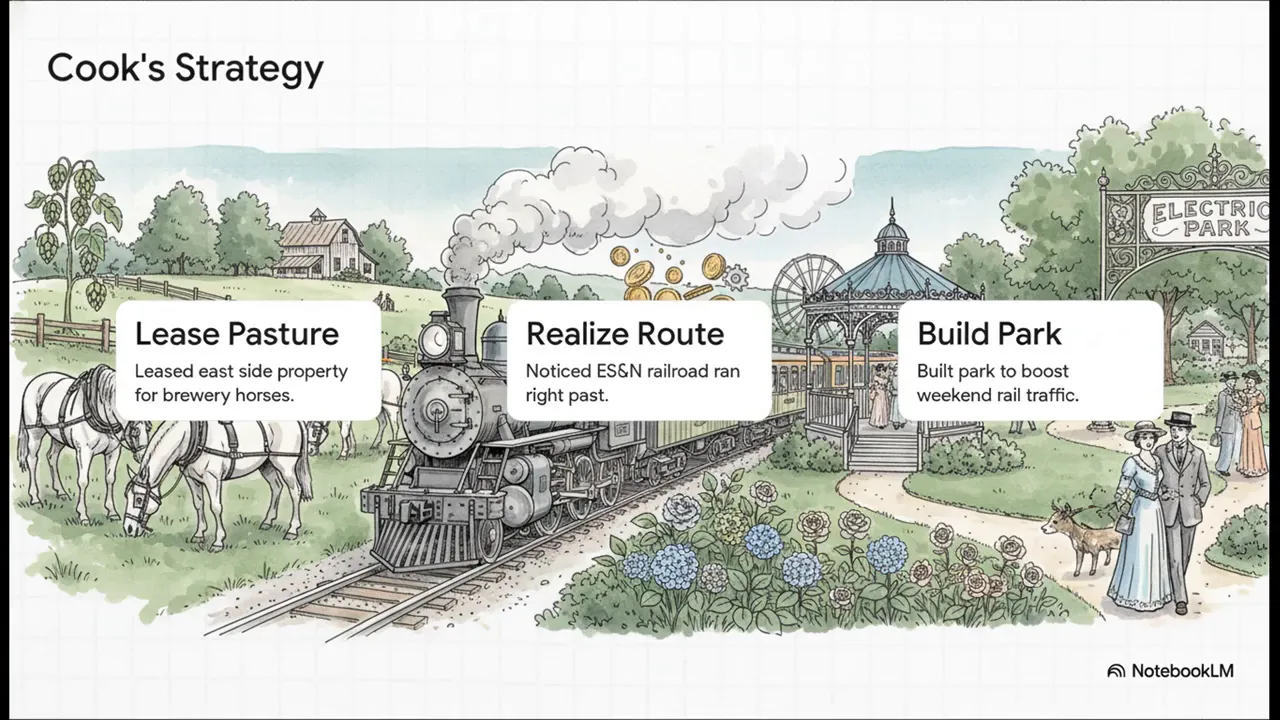
The railroad’s owner, F. W. Cook, also had a brewery, and he recognized a particularly useful connection between transportation and recreation.

Cook had leased property on Evansville’s east side as pasture for his brewery’s horses. The railroad passed right by it. That turned an otherwise practical piece of land into a business opportunity.

Build an appealing pleasure park beside the route, and people would have a reason to buy train tickets on Saturdays and Sundays. The railroad would not merely serve an existing destination. It could help create demand for one.

Illustrated Cook’s Strategy slide showing leased horse pasture, a railroad route, and a pleasure park
Cook connected land he already leased with a new reason for weekend rail travel.

It was a smart arrangement: the park supplied the attraction, the train supplied the access, and weekend passenger traffic supported the business.

The Golden Age of Private Groves

Cook’s idea fit neatly into a broader enthusiasm for outdoor recreation. Across the region, privately operated groves became places where people could gather, relax, and enjoy a change of scenery.

But what exactly was a grove?

In this setting, it was not a tangled patch of wilderness. A recreational grove was a carefully maintained landscape, with groups of similar trees, generous spacing, and underbrush cleared away. The appeal was nature made comfortable and accessible: shade overhead, open ground below, and room to stroll or spread out a picnic.

Cheap rail travel helped destinations such as Gilbert’s Grove, Kubler’s Garden in Newburgh, and Barnett’s Grove become regional gathering places.

Church groups organized outings. Companies held large picnics. Families could spend a day outdoors together without arranging a difficult journey of their own.

These pleasure grounds helped lay the groundwork for the modern American amusement park. Their central attraction was organized leisure: a place worth traveling to, shared entertainment, and a practical way to get there. For Evansville residents, they helped establish a new rhythm of weekend recreation.

Inside Barnett’s Grove

Barnett’s Grove stood about five miles from the city in Knight Township, between Newburgh Road and Washington Avenue. Earlier known as Olympic Park, it became one of the most popular destinations of the grove era.

Its reputation was not simply that of a convenient picnic ground. Historical descriptions emphasized its romantic beauty, portraying it as a refuge for sweethearts whose scenery belonged in poetry.

That gives us a sense of what people valued there. This was somewhere to escape the ordinary, meet friends, enjoy music, and spend an afternoon in surroundings that felt special.

A weekend beneath the poplars

On Saturdays and Sundays, thousands of people traveled out by rail to enjoy the grounds. A day at Barnett’s Grove could include:

  • Long walks through the cleared woods.
  • Organized games on the broad lawns.
  • Live musical entertainment.
  • Picnic lunches beneath a canopy of mature trees.

The trees were the park’s crowning feature. Great poplars spread their shade over the picnic grounds, offering relief from the summer heat. Historical accounts praised them as exceptionally beautiful, unlike anything else near Evansville.

It is easy to focus on the crowds or the entertainment, but that canopy was fundamental to the experience. The grove offered both a social destination and a comfortable outdoor retreat. Its beauty was not incidental to its popularity. It was the reason people wanted to linger.

When Cars Changed the Weekend

The great irony of Barnett’s Grove is that transportation helped create its success, then helped undo it.

Interurban trains made a nearby pleasure park an easy choice. But automobiles offered a different kind of freedom. Instead of choosing among destinations along a fixed rail route, people could select their own roads, travel farther, and shape an outing around their individual interests.

The train made the grove accessible. The car made countless other destinations accessible, too.

As automobile travel and highways expanded, local interurban service lost its importance. That weakened the dependable connection between the park and the crowds that had sustained it.

Without trains delivering large numbers of visitors to its doorstep each weekend, Barnett’s Grove faced a very different future.

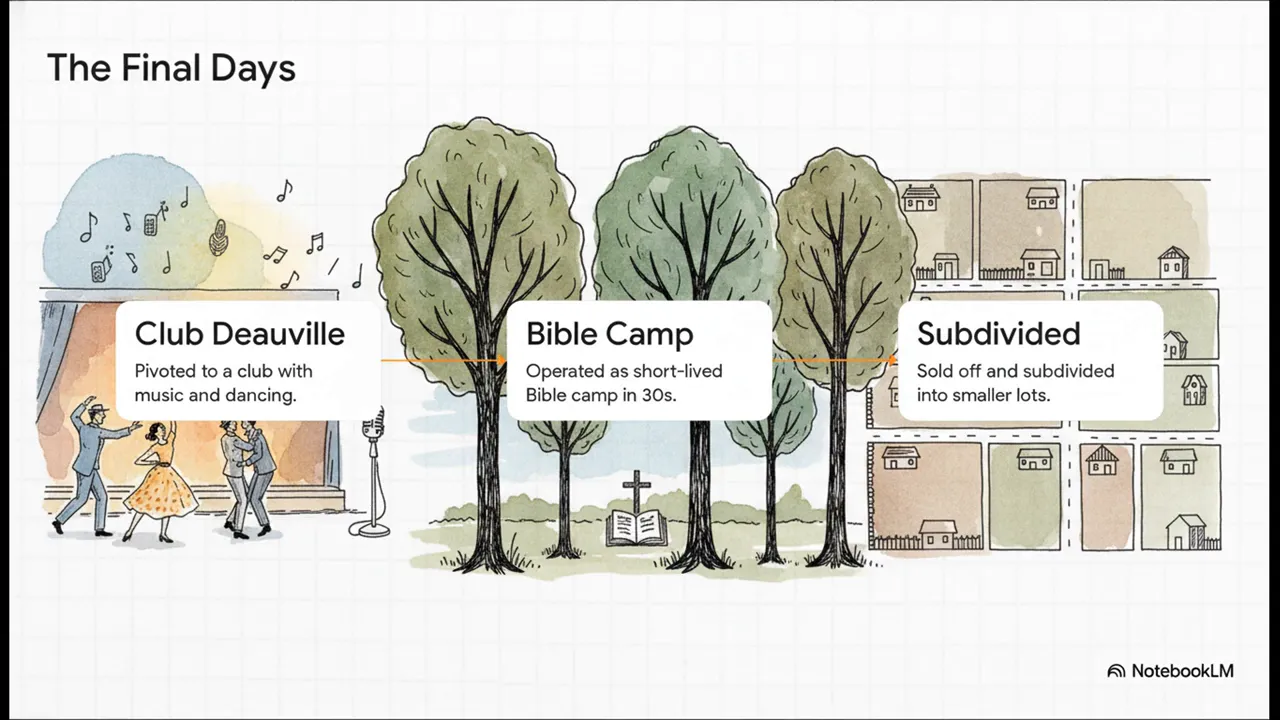
From Pleasure Park to Roadhouse to Residential Lots

The property did not immediately disappear into development. It went through several attempts at finding a new purpose.

  1. A roadhouse: The site became Club Deville, promoting live music and late-night dancing.
  2. A religious camp: In the mid-1930s, it briefly operated as a Bible Institute camp.
  3. Residential development: As those uses faded, the land was ultimately sold and subdivided into smaller residential lots.
The Final Days slide showing a club, a Bible camp, and subdivided residential lots

Each change moved the property farther from its original role as a shared weekend retreat. Music and dancing offered one way to keep it active. The camp offered another. Neither preserved the grove as the gathering place it had once been.

Eventually, even the magnificent poplars could not sustain the property’s old purpose. The broad grounds gave way to individual lots, and the landscape became part of an expanding city.

The History Beneath an Ordinary Commute

Today, the area between Newburgh Road and Washington Avenue offers little visible indication of the pleasure park that once drew such crowds. The great trees and picnic lawns are gone. Former railroad rights-of-way remain among the few traces of the transportation landscape that made the grove possible, largely obscured by development.

For anyone curious about how an urban landscape has changed, historical maps offer a useful starting point. The Library of Congress’s Sanborn Maps collection is one resource for exploring older street patterns and built environments, alongside local historical records.

Barnett’s Grove is more than a vanished Evansville landmark. Its story captures a larger shift in American life: from shared rail excursions to personal automobile trips, and from spacious pleasure grounds to residential neighborhoods.

What once felt permanent could disappear within a changing city. A place remembered for romance, music, and extraordinary trees could become an unremarkable stretch of someone’s daily route.

That is what makes this history worth remembering. The next time an ordinary road seems to have nothing to tell you, consider what might have stood beside it before the houses, before the traffic, and before the asphalt. Sometimes a city’s most surprising stories are hidden in the places we pass every day.

Made with VideoToBlog using Barnett’s Grove: The Rise and Fall of a Pleasure Park