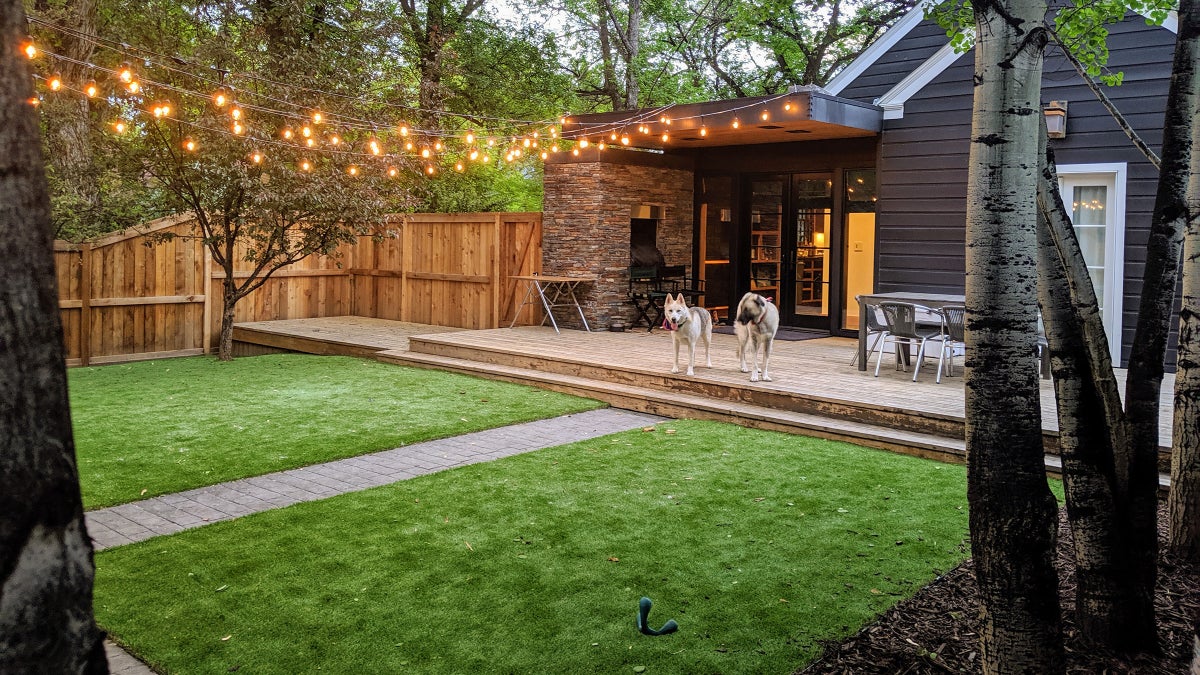
Three years ago, I had our small, fenced-in back yard replaced with synthetic grass. Was it expensive? Yes. But just look at the results. And this is what the yard looks like every single day, no matter what my three big dogs do to it. Here’s why astroturf is the single best investment dog owners can make to their home.
It only took Wiley, Bowie, and Teddy one year to completely destroy the natural grass in our back yard. It probably would have been less time, if the yard wasn’t blanketed in snow for five or six months.
And that destruction wasn’t just unsightly. All of that dirt and mud clung to their paws and fur, so every time they came inside, they tracked it all over our shiny black floors and nice furniture. Owning three big dogs already requires a lot of work. (Think: shedding, exercise, diet, and shenanigans.) So, having to bust out the mop multiple times a week, too, just felt egregious.

Worse still, our yard’s exposed dirt would bake into a crust during warmer, drier months, and hold onto urine, and the small remnants of poop I was unable to pick up. On hot days, it smelled like shit—literally. Hanging out on our back deck became untenable.
None of this was the dogs’ fault, of course. They want to run and play, and need to poop and pee. Being able to let them out to do that, without leashing them up and taking them for a walk every single time is why we have a yard.
Running through the various options, nothing else other than astroturf seemed viable. A dry scape doesn’t fit with the natural ecosystem outside our home, here in Montana. Plus, the dogs would kick up rocks, tear up plants, and dig like crazy. Simply replacing the grass with something less muddy—gravel, maybe—wouldn’t look good. And paving the yard didn’t sound appealing either, even if we used nice flagstones.
I did look into installing the astroturf myself, but the process requires more than just laying down strips of synthetic grass. The entire yard needed to be excavated to a depth of 12 inches, then layers of gravel and sand needed to be poured and tamped. Our existing in-ground sprinklers needed to be removed and the pipe that fed them needed to be capped so we could keep using the system in our natural front yard. Not only was I worried that my ambition might exceed my talent—there’s nuance to installing specialized materials—but the cost of renting tools, plus DIY time, all pointed to a headache-free professional installation.
Finding an installer was easy, since there’s only one in the entire state of Montana—JW Synthetic Grass. I scheduled a consultation, and Josef, the owner, came over with several product samples.
While all synthetic lawns are porous, the gaps in the back of products designed specifically for dogs are much larger. This facilitates the easy flow of urine, and even the passage of small pieces of solid waste through the material. In the samples, I was able to watch the woven backer as it retained the tufts of polyethylene which form the synthetic grass blades. Josef assured me that end result is virtually indestructible (the only thing you have to worry about is melting it with a fire pit or another heat source), something he backed up with a 20-year warranty. He also offered a sand blended with a deodorant specifically formulated for dog urine. While the substrate is designed to flow liquids into the soil underneath, it’s inevitable that some will gather under the grass, so he explained that it would help prevent pervasive smells.
Between labor and materials, the job ended up costing about $7.50 a square foot. That rate would have been lower for a larger yard. We also chose one of the more expensive types of synthetic grass, with longer, softer, more natural looking blades. Five guys showed up and knocked out the job in two afternoons.
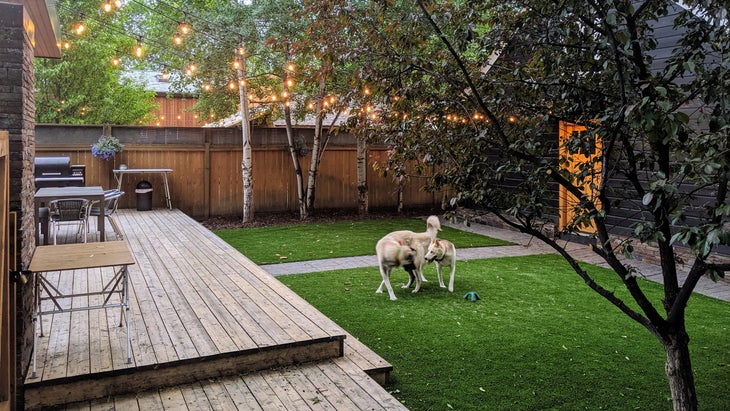
Three years of pees, poops, claws, teeth, and weather later, it looks as good as it did that first evening. The dogs no longer track mud into the house. I put maybe half a day of labor into the backyard in the space of a whole year. It looks great, when the snow stops long enough that you can actually see it. Bottom line: my wife and I are happy customers.
Pet-Friendly Artificial Grass: What It’s Really Like
I get a lot of questions from other dog owners, so here’s what living with a synthetic lawn is like—with answers below.
1. Can the dogs damage it?
The polyethylene grass itself is virtually indestructible. Dogs cannot damage it by running around on it, or even chewing it. The sheets are secured into the compacted substrate with foot-long nails. A large, determined dog can pull up a corner if it really wants to try, as one of our dogs has done to one corner, before digging a hole in the sand beneath. All I had to do to fix it was fill the hole, and pound the nail back in. They haven’t bothered it since.
2. What’s maintenance like?
I pick up poop once a day. Because we feed our dogs a healthy diet of raw meat, organs, eggs, and bones, they produce about one-third the volume that dogs fed kibble would. That poop is also firm, and doesn’t smell nearly as bad. Some crumbs are left behind. Rain will wash those through the woven backing, as will a garden hose. During winter, some poop does get left behind. Extrapolate that across 300 pounds of dog, and the spring melt can leave the yard looking pretty gross. Once the snow and ice have melted enough to make it possible, I pick up all that leftover poop by hand, then thoroughly rake the yard free of all other debris, before pressure washing it with a 15-degree nozzle. The rake fluffs the blades, and the pressure washer gets them nice and clean. I usually only need to do a complete pressure wash once a year, but I will spot clean it if there’s gross diarrhea. In summer months, I deodorize the lawn with Simple Green Turf Deodorizer every two weeks or so, or before we have people over. In the fall we rake leaves like everyone else. That’s it.
3. Does it get hot?
Our 650-square-foot back yard has southern exposure and sits between the house and garage, which are both painted black. It’s unshaded by the elms on the north side most of the day. On days where temperatures exceed 90 degrees, the turf does become warm to the touch, and the dogs avoid laying on unshaded areas. It doesn’t trap enough heat to make hanging out back there unpleasant, but I know some people who like to use a sprinkler on their astroturf lawns on the very hottest days.
4. Do you feel comfortable walking on it barefoot?
The yard can be as clean as you want it to be. Since this is our entertainment area in the summer, I keep it spotless. The material is much softer than the crinkly astroturf materials you’ll find at a home supply store.
5. Does it get stiff in winter?
I’ve never observed this. Snow and ice lay on top of, rather than cling to, the blades. They have remained pliable through temperatures as low as 26 degrees below zero.
6. Is it hard, and does the yard get lumpy?
Sitting or walking on the turf feels just like sitting or walking on a natural grass lawn. I don’t worry about taking a tumble on it. Nor has any human or dog activity displaced the substrate enough to create any apparent lumps.
7. Is it environmentally friendly?
Every yard is different. While the artificial turf will eventually end up in a landfill, the time for that is two, if not three decades in the future. And in that time, we’re saving immense amounts of water, energy, and chemicals. Ultimately, the answer to that question will depend on what part of the country you live in, and the standard of lawn upkeep you maintain. Perhaps more importantly, synthetic grass may prevent your dog from ingesting or absorbing chemical fertilizers through their skin.
8. Is it cheaper than maintaining a natural lawn, over time?
I’m going to have to devote a full day this weekend to preparing our natural front lawn for spring. It’s about twice the area of the backyard, and I’ll probably spend about $100 on seed and another $50 on fertilizer. Before I spread that seed and fertilizer, I’ll need to aerate. Covering a 1,300 square foot lawn in an inch of water takes 806 gallons every time, but our water isn’t metered, so that’s cost neutral. I did have to buy a new electric lawnmower last year, at a cost of $250. Assuming an annual lawn maintenance cost of $200, it take 25 years to break even on synthetic grass. It’s neat that this trajectory also works out to the rough life expectancy of astroturf, but no, I did not install it to save money. I installed it to make living with dogs easier. And considered in that context, it’s an investment that’s already paid for itself.
The post Pet-Friendly Artificial Grass: The Ultimate Yard Upgrade for Dog Owners appeared first on Outside Online.
by wsiler via Outside Online
Comments